Vinyl fence.
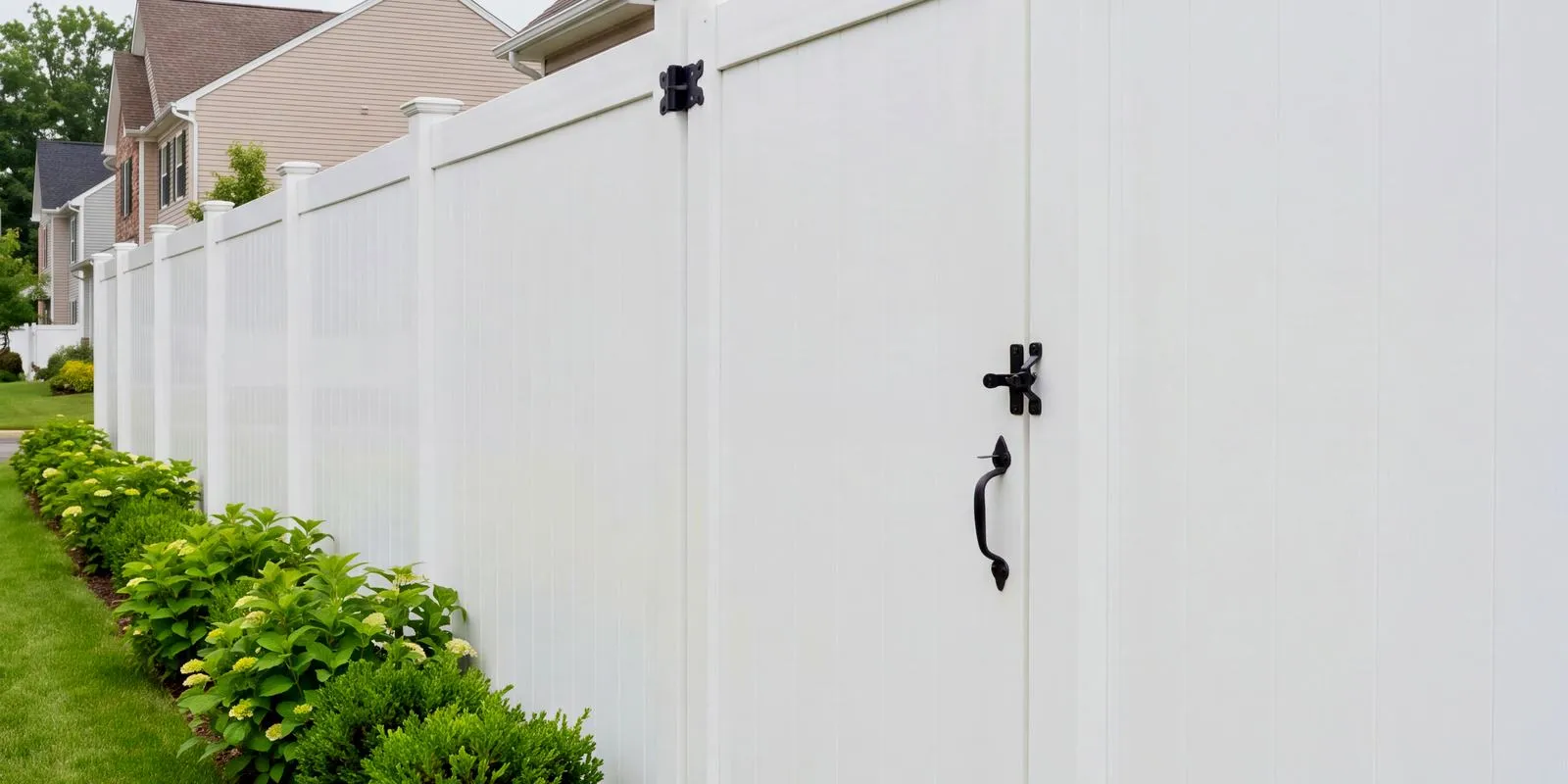
White or tan privacy panels in a steel-reinforced bottom rail. Costs more than cedar on day one and asks nothing of you after that.
- White or tan
- Steel-reinforced bottom rail
- Nothing to stain
- From $36 per foot
Tongue-and-groove pickets slotted into a top and bottom rail between vinyl posts, with a cap on each post. It gives you the same solid screen as a cedar privacy fence, in a material that does not absorb water, does not warp and does not need to be stained.
The bottom rail is the part worth asking about on any vinyl quote. On a long panel it carries the weight of every picket, and a steel-reinforced bottom rail is what keeps the middle of the panel from bowing down over the years. That is what we install.
White is the default and tan is the common alternative. Colour is moulded through the material rather than painted on, so a scratch does not show a different colour underneath.
Heights, styles and gates
- 6 ft solid privacy is the standard, and what most of our vinyl work is
- Lattice or spindle top panels trade a little privacy for light and a softer line
- Picket and semi-privacy styles for a front yard or a boundary you want to see over
- Walk and double drive gates in matching panels, on a reinforced frame
- Self-closing, self-latching hinges on any gate that encloses a pool
Vinyl comes in fixed panel widths, so a run gets laid out in whole panels with the remainder cut at the end. Where that lands matters on a short run, and it is one of the things we work out on site rather than over the phone.
What moves the price
- Panel style: solid privacy, semi-privacy, lattice top, picket
- Every gate, and whether it is a walk gate or a double drive gate
- Tear-out and disposal of the existing fence
- Slope, because vinyl panels rack less than a wood fence does — a steep grade may need the run stepped down instead
- Rock, roots and hard digging on the post line
- Corners, ends and short runs, which need more posts per foot
Vinyl runs higher per foot than cedar up front. Whether it is cheaper over the life of the fence depends on how long you are staying and whether you were ever going to stain the cedar.
Life and upkeep
There is no stain, no sealer and no re-painting. It gets washed down with a hose and a brush when it looks like it needs it, which in this part of the country is usually once a year after the winter.
Vinyl does not rot and insects do not touch it. In the cold it gets more brittle than wood does, so the two things that actually damage a vinyl fence here are a plough throwing snow and ice into a panel, and a mower or a trimmer catching the bottom rail.
Worth knowing before you buy
A damaged vinyl picket cannot be sanded or patched the way a cedar board can. It is replaced — which is straightforward, but it means matching the profile and the colour, and both drift over the years as manufacturers change lines.
If long-term matching matters to you, raise it at the estimate and ask what we are quoting. Warranty terms come from whoever makes the panel, not from us, so we will point you at the actual document rather than repeat a number at you.
Comparing vinyl against cedar?
Same privacy, different bill — cedar is cheaper to install and wants attention, vinyl costs more and wants none. Look at all six, or have us price both.
Get both numbers on one sheet.
Free on-site estimate, usually the same week. We will measure the run once and quote vinyl and cedar side by side if that is the decision you are stuck on.
Rather talk? (814) 555-0143
Free estimate
We don't sell your information. One call to schedule, and that's it.